
Thoughts · Natural Frequencies
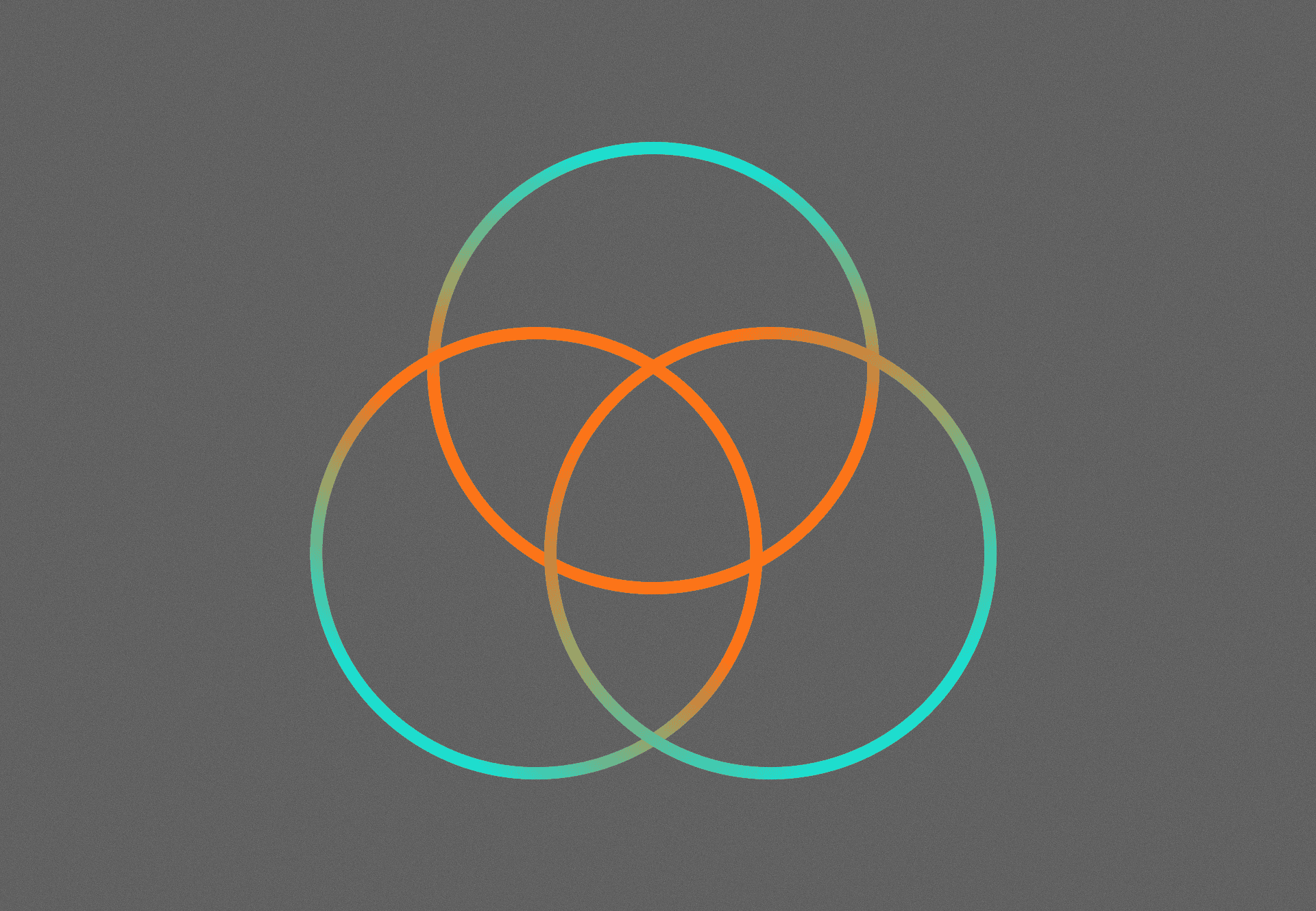
The Venn diagram of your actual life
We tend to know people in one dimension. The context where we met them sets a container for everything that follows. Your college friend is forever your college friend. Your coworker is your coworker. The guy you’ve seen at music shows for twenty years is the guy you see at shows.
All my eras on one big patio
I moved back to the Austin area in the summer of 2023 after more than a decade away. Dallas, Nashville, back to the Dallas suburbs, and then finally home. Less than a month after we’d settled in, my friend Topher asked if I was going to see Son Volt play The Scoot Inn.
Son Volt is a band we’ve both loved since we were teenagers. And they weren’t just playing their own stuff — they were doing a set of Doug Sahm’s greatest hits. Doug Sahm, who put Texas music on the map before most people knew what to call it. For that to be happening at The Scoot Inn, a venue I’d played during my first life in Austin — it felt like the city had saved something for me.
The show was sold out and I didn’t have plans to go, but that evening I found myself free around nine o’clock and drove over to check it out. Son Volt was already mid-set when I walked up and the ticket guy just waved me in. They were finishing up the Doug Sahm set — "Is Anybody Going to San Antone" ringing through the air — and then they shifted into songs from their record Drown, another formative, personal favorite.
But the music, as good as it was, wasn’t the thing that blew my mind.
It was the faces. I kept seeing people I knew. Dozens of them. Different eras, different circles — people from bands I’d played with, people I’d worked alongside, people I hadn’t seen in fifteen years, people I’d seen last month. Groups that didn’t know each other, except that I happened to be a thread running between them. I was moving between clusters of old friends, catching up in the spaces between songs, and then the show ended. Closing time came too soon.
It felt less like a concert and more like a homecoming I didn’t know I needed.
A wider lens
That night I had a feeling I didn’t have language for yet. It was the sense that my life in Austin was bigger than I’d realized — that the people I’d accumulated over the years were connected to me in ways I’d never fully mapped. I just hadn’t been around to see it.
It wasn’t the first time I’d felt something like it. A few years earlier, before moving back, I’d gone all in on Western Gallery and was hosting pop-up exhibitions in Austin. It was so fun to see people from completely different parts of my life show up to the events. I’d find myself walking someone I knew from music through an artist’s work, or reconnecting with an old classmate over a glass of wine in a gallery I’d built from scratch. People who’d only ever known me in one way were suddenly seeing me in a wider frame — and I was seeing them with more context, too.
What I’m in the middle of now is a variation on the same thing. A different catalyst, but the same pattern: step outside the identity your career has assigned you, and the people around you come into sharper focus.
A friend I already had
I was at a matinee concert one afternoon at the Aristocrat, and I saw a friend I’d known pretty casually for close to twenty years. He’s really more of a friend of a friend, someone I’d always seen in the context of music. We’d talked plenty of times, but always about bands, music, friends in common.
I don’t remember exactly how the conversation turned. Maybe a third person asked him something about his day job. But he started talking about his work in the marketing industry — client management, sales strategy, the kind of stuff I’ve spent my career thinking about. He was clearly good at it — smart perspective on client relationships, the kind of sharp dude that I knew from our casual conversations but had never seen applied to work. We got into it for a while — how different clients respond to direction, how it takes a real creative advocate to achieve high-end work, how you build trust with someone who’s paying you to have opinions.
I walked away thinking: I’ve known this guy for two decades and had no idea we were in the same industry.
It wasn’t that he’d been hiding it. I just never thought to ask. The context where we’d met — music, shows, that particular circle — had dictated a boundary around our relationship, and neither of us had ever thought to cross it before.
I sent him a note to see if he wanted to have lunch, and before we even sat down, the conversation picked up where we’d left off, but deeper. He told me about his company, his read on the industry, what he was seeing in the market. I told him where I was in my own career, what I was looking for. We can’t say yet whether this new professional connection will lead anywhere. But something had shifted. A twenty-year acquaintanceship had quietly become a real friendship, with a whole new dimension neither of us knew was there.
People are more than one thing
I’ve been doing a lot of these catch-up hangs recently, and each time, it’s the same thing. I’ll sit down with someone I’ve known for years and learn something that changes how I think about them — a career pivot I missed, a side project I never heard about, a family that’s grown in ways I couldn’t have predicted. People have kids now. People’s KIDS have kids. People have changed industries. People have stories that have nothing to do with the version of them I’ve been carrying around in my head. And it’s wonderful to reconnect.
The tempting explanation is that it’s just a function of time — people grow, and if you’ve been away for a while, of course there’s a lot to catch up on. But I don’t think that’s the whole story. Maybe it’s just what happens when you’ve been around long enough to stop sorting people into categories. Your life gets wider, and you start paying attention to the whole person instead of the part that’s relevant to whatever you’re doing at the time.
When you’re employed and settled, your social connections are social and your work connections are work. Especially if you’re not in sales or business development, you’re not especially curious about where there might be overlap. But when that structure falls away — when you’re between things and your calendar opens up and you’re not networking so much as just reconnecting — the walls come down. You ask different questions. You listen for different things. And other people do the same.
Where circles overlap
I used to think of my professional network as the people I knew through work. The ones I’d collaborated with, reported to, shared an industry conference with. That’s the way we’re taught to think about it — your network is your career graph, and the nodes are defined by proximity to what you do for a living.
But the real network is every relationship you have, seen fully. The musician who turns out to be a marketing strategist. The college friend whose career took a turn you never heard about. The dozens of faces at The Scoot Inn who each represent an entire dimension of connection you’ve never explored.
The depth was always there. I just had to stop and smell the flowers long enough to see it.
How this was made
| Layer | George | AI |
|---|---|---|
| Concept | 88 | 12 |
| Direction | 85 | 15 |
| Research | n | a |
| Structure | 55 | 45 |
| Voice | 80 | 20 |
| Wording | 50 | 50 |
| Authorship | 83 | 17 |
- Foundation reliance
- 55 → −16% applied to AI
- Foundation used
- voice + style rules, project context
- Confidence
- Medium
How the score works: Who wrote this, really?
Get on the list
Get Natural Frequencies delivered to your inbox directly. Unsubscribe anytime.
What are you working on?
Let’s chat about what you’re making and where you need support. If I can help, we’ll chat about how. If I’m not a good fit, I’ll let you know.
15 minutes to see if we’re a fit.