
Thoughts · Natural Frequencies
Ten cents on the dollar
The economics of building custom tools for businesses has changed dramatically. The problems that weren’t worth solving suddenly are.
A few weeks back I wrote about “bounded deliberation” as a practice to decide what to start building. The piece ended with a soft promise: I’d share more when the thing I was building was ready.
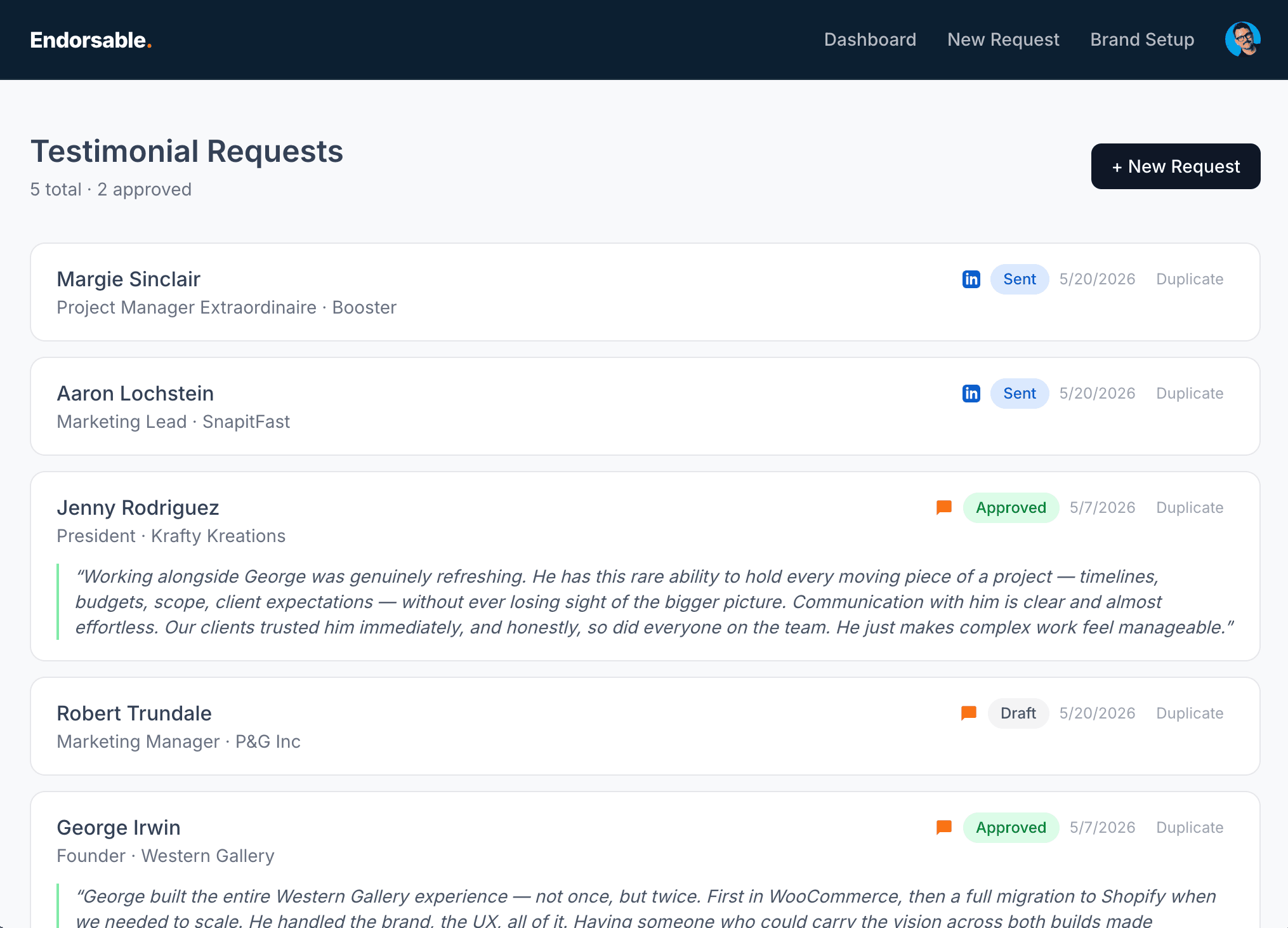
It’s ready. It’s called Endorsable (opens in a new window). It solves a problem I’ve had for years: getting good client testimonials. It always felt presumptuous every time I wanted to ask for a testimonial, and when I did, the reply was either silence (client too busy) or two sentences I couldn’t really use without heavy editing. I have a long list of people who’d likely say great things if I made it easy.
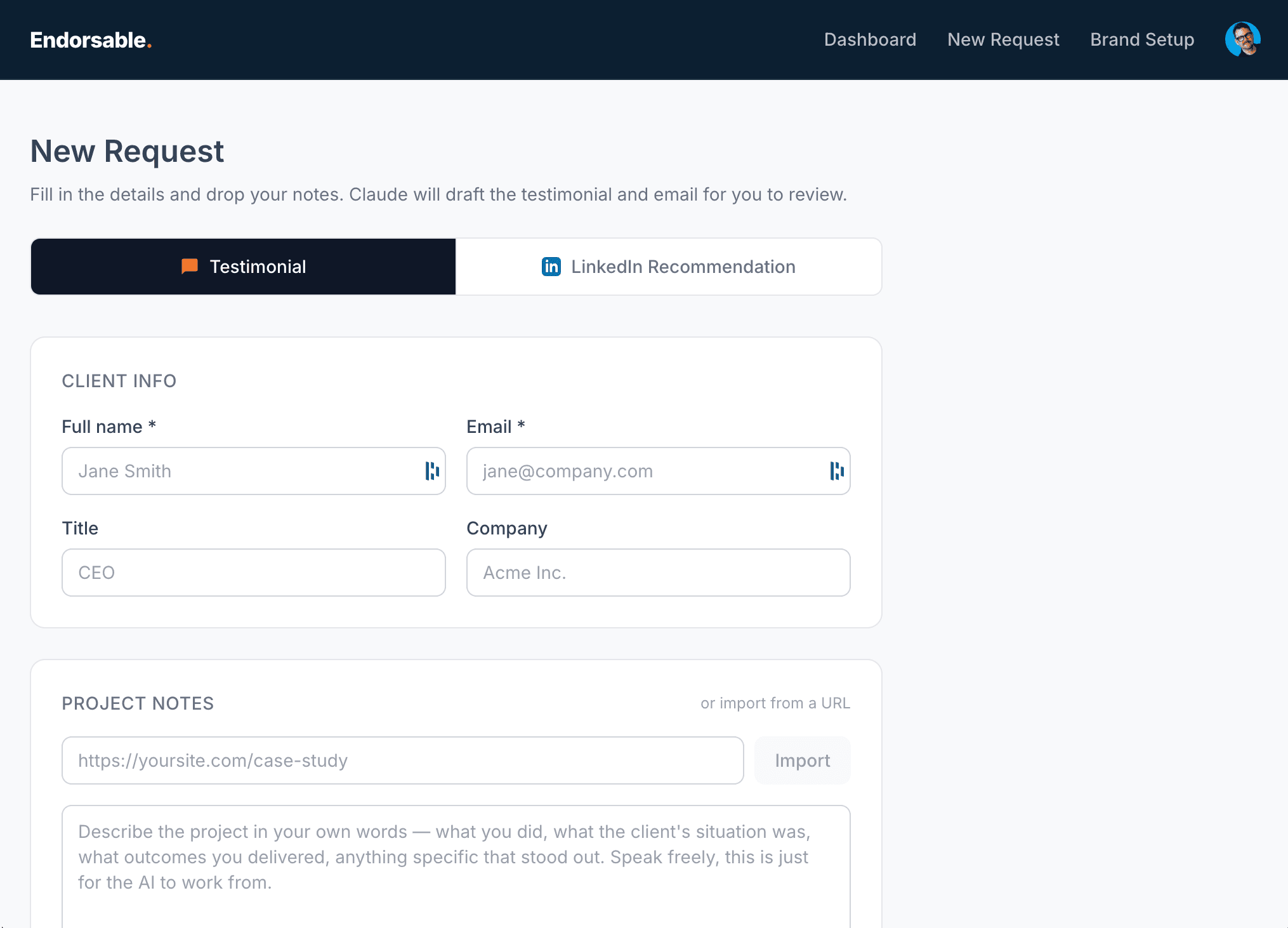
Learn more at www.endorsable.works ↗ (opens in a new window).
So I built a tool to remove the friction. I enter a few notes about a finished project. Endorsable drafts a starting point in an approximation of the client’s voice and a warm outreach email from me to go with it. I review and/or edit both. The client gets one link with three buttons: Approve as-is, Edit, or Pass. No login for the client. No friction.
It took me about three days from sitting down with the idea in Claude Code to build a fully functional multi-user SaaS app and create a marketing site for it.
So the build itself is an interesting topic, but what I find really wild is the change that this promises for the business technology consulting market, and smaller businesses in general.
The economics have changed dramatically
According to Clutch’s 2026 pricing data (opens in a new window), the average custom software project costs $132,480, with a typical delivery timeline of 13 months. Mid-market organizations such as regional healthcare networks modernizing patient intake systems or manufacturers building custom warehouse management applications allocate $120,000–$300,000 for integrated systems (opens in a new window). Enterprise builds start at a quarter million and go up from there.
Those numbers are the reason most businesses don’t build the tools they need. Not because the problems aren’t worth solving, but because the economics forbade it. Yes, I said “Forbade.” A $40,000 problem isn’t worth a $200,000 fix, so it’s never fixed.
AI can work magic, but you have to be a magician to wield it well
There’s a version of this story that I’m seeing frequently, but it’s not the whole truth: Anyone can build software now, the gatekeepers are gone, we’re all developers. We’re not quite there yet. Or at least we’re not quite to the point where anyone can build really functional, useful software yet.
For Claude Code, the command line is part of it. AI will tell you exactly what to type, but you have to be the kind of person who’ll type it without flinching when something fails, and you have to be willing and able to learn a bit of nerd computer language. That’s a real limitation, and it knocks out most people on its own.
Beyond that, AI is good at taking a request and producing something that more or less works. Ask Claude Code to build a form that captures testimonials and routes them to an email, and it will. The baseline app function it produces is fine.
The story falls apart when you need anything beyond baseline. What should this flow actually feel like for a client who’s already a little uncomfortable being asked? Why is one layout obvious to use and another a wall? Why does this copy land and that copy read as spam? What happens when you add another layer of complexity? Those questions need to be handled by someone with the design experience and systems thinking to know how interfaces can improve an experience rather than make it onerous. AI can execute against that judgment, fast, but it can’t reliably supply it. Strip it out and what you have is a working app that nobody wants to use.
To me, the interesting thing about this moment that the standard story isn’t really telling is that the people who already know how to build well—the magicians, as it were—can do it ten times faster and at a fraction of the cost. The $132,000 project becomes a $15,000 project when the person at the keyboard knows what to ask for and what to throw away. The 13-month timeline becomes a few weeks. The problems that weren’t worth solving suddenly are.
An exciting moment for builders, and more exciting for businesses
The interesting story isn’t that I built an app in three days. The interesting story is what happens to a business when the cost of building a custom tool drops by 90%.
The list of problems that don’t justify a $200,000 build is enormous. Internal dashboards still in Excel, customer onboarding flows still running on email and forwarded PDFs. Manual reporting. Approval processes that take five days because they have to move through five people. I’d wager that most companies/orgs have a backlog of these. A long, quiet list of "we should really fix that someday," but someday never comes because it hasn’t been worth it.
But now the economics work and someday can be this quarter. The tool that captures the revenue you’re leaving on the table pays for itself in no time. The internal friction that’s costing you a hire’s worth of time per year gets removed for less than that hire’s monthly salary. The custom CRM you couldn’t justify in 2023 is a long weekend in 2026.
That’s a story that has my attention. Custom tools at 10% of the cost in both dollars and human capital. Ten cents on the dollar.
What I’m doing with this
Endorsable is one example. It’s also a proof of concept for me for one aspect of what I’m doing professionally now.
I’ve spent twenty-plus years figuring out what businesses actually need to communicate, what their customers actually hear, where the gap is between what a company says and what a company does. That’s the design and systems work. What’s newly possible is closing those comms gaps and more… by economically building tools to fix them and actually improve ROI instead of just delivering a recommendation doc that may or may not ever get implemented.
If you’re a founder or a leader with one of those quiet backlogs: a list of things you’d fix if the math worked — it probably does now. I’d like to hear about it.
My Endorsable project is in early access at www.endorsable.works (opens in a new window). I’m letting a small group in to put it through real use; let me know if you’d like access.
And if you have a problem in your business that’s been sitting on the "too expensive to solve" list, please send me a note. I want to know what’s on it.
How this was made
| Layer | George | AI |
|---|---|---|
| Concept | 90 | 10 |
| Direction | 88 | 12 |
| Research | 55 | 45 |
| Structure | 60 | 40 |
| Voice | 80 | 20 |
| Wording | 45 | 55 |
| Authorship | 83 | 17 |
- Foundation reliance
- 55 → −16% applied to AI
- Foundation used
- prior drafts, voice + style rules, project context
- Confidence
- High
How the score works: Who wrote this, really?
Get on the list
Get Natural Frequencies delivered to your inbox directly. Unsubscribe anytime.
What are you working on?
Let’s chat about what you’re making and where you need support. If I can help, we’ll chat about how. If I’m not a good fit, I’ll let you know.
15 minutes to see if we’re a fit.